
Streaming a show on Netflix and watching live TV through a cable-style set-top box both deliver video over the internet. Yet they work in very different ways. OTT (Over-the-Top) delivers content directly to your device over the public internet, while IPTV delivers television through a managed network run by a service provider.
This guide explains both technologies, compares them side by side, and helps you decide which one fits your viewing habits.
Key Takeaways
- OTT (Over-the-Top) streams video over the open internet to any connected device, with no dedicated provider network required.
- IPTV delivers TV channels using Internet Protocol, often over a managed network with set-top boxes and guaranteed bandwidth.
- OTT is usually app-based and on-demand. IPTV is usually channel-based and live.
- Cost, quality control, device flexibility, and content licensing are the main differences.
- The terms overlap in everyday use. Many modern IPTV services now run through apps over the open internet.
What Is OTT (Over-the-Top)?
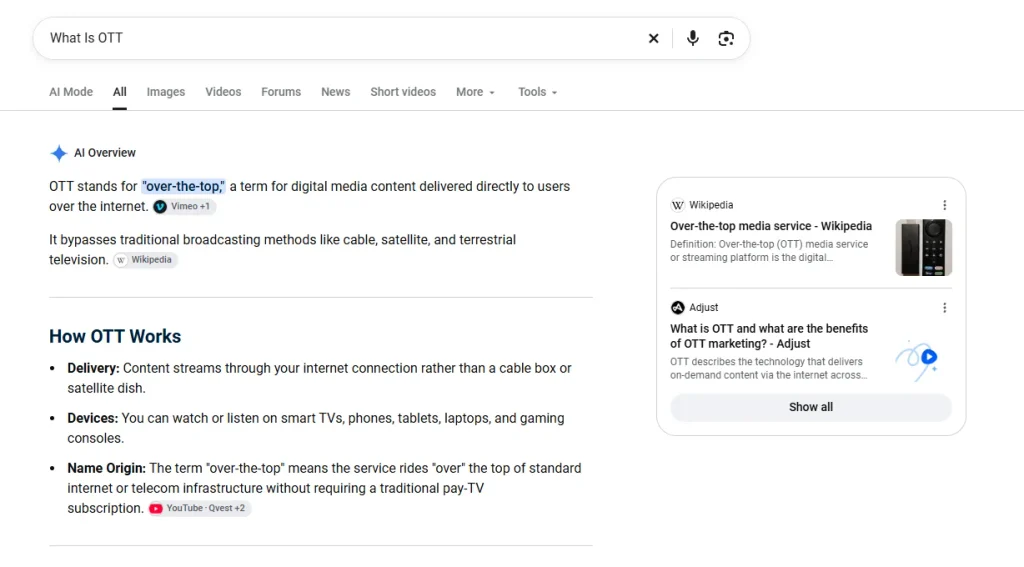
OTT, short for Over-the-Top, is a method of delivering video, audio, and other media directly to viewers over the internet. The name comes from the fact that content goes “over the top” of traditional cable, satellite and broadcast infrastructure. You only need an internet connection and a compatible device. For a formal definition, see Wikipedia’s overview of over-the-top media services.
Netflix, Disney+, Amazon Prime Video, Hulu, and YouTube are the most familiar OTT platforms. Each runs its own app, charges its own subscription (or shows ads), and controls its own catalog.
How Does OTT Work?
An OTT provider stores video files on servers and distributes them through a content delivery network (CDN), so viewers get fast playback from a nearby server. The app on your phone, smart TV, or streaming stick requests the video, and the provider sends it over your home broadband or mobile data.
To prevent buffering, OTT platforms rely on adaptive bitrate streaming. This technique automatically raises or lowers video quality based on your connection speed. That is why a stream may start in lower resolution and sharpen after a few seconds.
Common Types of OTT Services
OTT covers more than movies and series. The main categories are:
- SVOD (Subscription Video on Demand): Netflix, Disney+, Max.
- AVOD (Advertising-based Video on Demand): YouTube, Tubi, Pluto TV.
- TVOD (Transactional Video on Demand): pay-per-rental or purchase on Apple TV or Google Play.
- Live OTT TV: YouTube TV, Sling TV, Fubo, and similar “skinny bundles.”
- OTT audio and messaging: Spotify, WhatsApp, and Skype also qualify as over-the-top services.
If you want the on-demand side explained in detail, read our guide to what is VOD.
What Is IPTV?
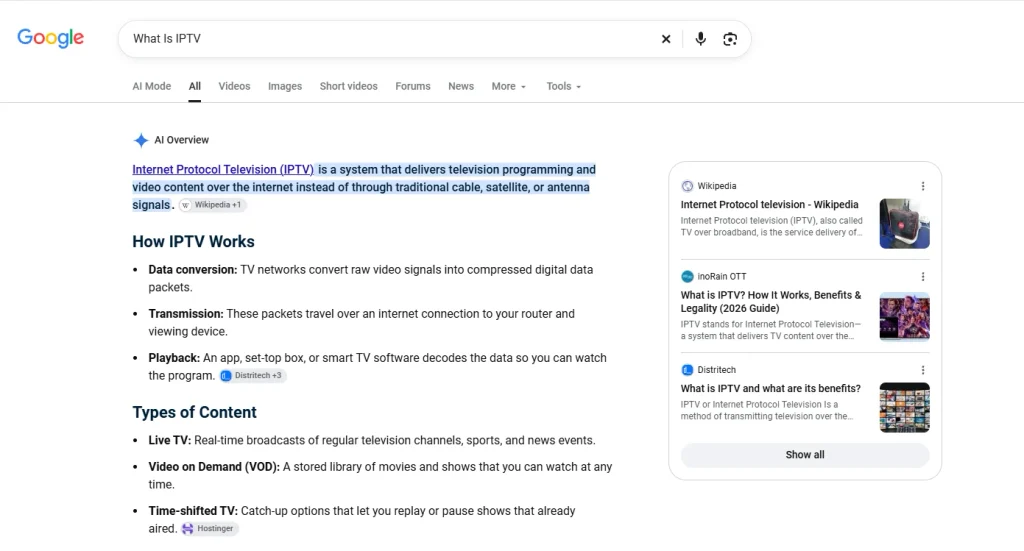
IPTV stands for Internet Protocol Television. It delivers television programming, usually live channels, as data packets using the same protocol that powers the internet. Our full explainer on what is IPTV covers the technology in depth, and Wikipedia’s IPTV article gives a technical overview.
Traditional IPTV was built by telecom companies such as AT&T U-verse, BT TV, and Bell Fibe TV. These providers ran television over their own managed networks. That gave them tight control over bandwidth and picture quality.
How Does IPTV Work?
An IPTV provider receives channel feeds, converts them with an IPTV encoder, and sends them to subscribers as IP streams. Viewers watch through a set-top box, a smart TV app, or a media player.
Most IPTV platforms include an electronic program guide. Learn how that works in our article on what is EPG in IPTV. Many also offer extras such as catch-up TV and cloud DVR recording.
Types of IPTV Delivery
IPTV typically comes in three forms:
- Live television: real-time channel streaming, similar to cable.
- Time-shifted media: catch-up and start-over features for recently aired shows.
- Video on demand: a library of titles you can play at any time.
OTT vs IPTV: Key Differences
The simplest way to separate OTT and IPTV is to look at the delivery path. OTT travels across the open, public internet. Traditional IPTV travels across a private, operator-managed network. The table below summarizes the main differences.
| Feature | OTT | IPTV |
|---|---|---|
| Delivery network | Public internet | Managed network or internet (provider-dependent) |
| Content type | Mostly on-demand, plus some live | Mostly live channels, plus VOD |
| Access method | Apps on any device | Set-top box, smart TV app or player app |
| Quality control | Depends on your internet speed | Higher control on managed networks |
| Provider requirement | None; anyone with internet can subscribe | Often tied to an ISP or telecom |
| Pricing model | Per-service subscriptions or free with ads | Bundled channel packages |
| Examples | Netflix, YouTube, Disney+ | BT TV, Bell Fibe TV, Deutsche Telekom MagentaTV |
1. Network and Delivery
OTT content competes with all other internet traffic in your home and across your ISP. If your connection slows, video quality drops. Managed IPTV reserves bandwidth for television, which keeps playback steady even during busy hours.
2. Content and Viewing Style
OTT platforms focus on choice. You pick a title and watch it when you like. IPTV focuses on the channel experience, with scheduled programming, live sports and news, plus on-demand options added alongside.
3. Devices and Accessibility
OTT works on nearly any internet-connected screen, including phones, tablets, laptops, smart TVs, and consoles. IPTV traditionally required a dedicated box. Today, many IPTV services also run on devices like Roku and through apps on iOS.
4. Cost and Contracts
OTT subscriptions are usually monthly and cancel-anytime, but costs add up when you subscribe to several services. IPTV packages often bundle many channels into one price. They may involve longer contracts when sold by a telecom provider.
5. Reliability and Streaming Quality
Managed IPTV networks can guarantee quality of service because the provider controls the entire route. OTT cannot make the same guarantee, since it depends on the open internet. However, modern CDNs and adaptive streaming have narrowed that gap considerably.
IPTV vs OTT: Where the Lines Blur
Many people searching IPTV vs OTT discover that the two terms overlap. A growing number of IPTV services now deliver streams over the public internet through apps, which technically makes them OTT delivery. Live TV services like YouTube TV and Sling TV behave like IPTV from a viewer’s perspective, yet they are OTT platforms.
In practice, the useful distinction is this: IPTV describes the kind of service (television over IP), while OTT describes the delivery path (over the open internet). A service can be both.
Playlist and Login Methods in IPTV Apps
IPTV apps usually load channels through a playlist link or a portal login. If you use a third-party player, understanding M3U playlists and Xtream Codes, or the difference between an M3U URL and MAC address activation, will save setup time. For first-time users, our how-to-use IPTV guide walks through the process.
Advantages and Disadvantages
Advantages of OTT
- No contracts, cancel any time.
- Works on almost every device.
- Huge on-demand libraries and original productions.
- Free ad-supported options are available.
Disadvantages of OTT
- Subscription costs add up across multiple services.
- Quality depends on your broadband speed.
- Live sports and channels are often split across several platforms.
Advantages of IPTV
- Large channel lineups in a single package.
- Strong live TV and sports coverage.
- Features such as catch-up, DVR, and program guides.
- Stable quality on managed networks.
Disadvantages of IPTV
- Set-top boxes or provider lock-in may apply.
- Unlicensed services carry legal and security risks.
- Fewer exclusive original shows compared with major OTT platforms.
Is IPTV Legal?
IPTV technology is legal. What matters is whether the provider holds the rights to the content it streams. Licensed services are fully legal, while services that resell channels without permission may violate copyright law.
Regulators in each region publish guidance on legitimate television services. You can review the FCC’s consumer resources in the US, Ofcom’s guidance in the UK, and the CRTC in Canada. For a deeper look, read our article on whether IPTV is legal and browse legal IPTV options.
OTT vs IPTV: Which Should You Choose?
The right choice depends on what you watch and how you watch it. Use these scenarios as a guide.
- Choose OTT if you prefer on-demand series and films, want flexibility to switch services monthly, or watch mostly on mobile devices and smart TVs.
- Choose IPTV if you want traditional live channels, follow sports and news closely, or prefer a bundled package with a program guide.
- Combine both if you want a main live TV service plus one or two on-demand subscriptions for originals.
Whichever route you take, test any service before committing. Our list of the best IPTV services is a practical starting point. Viewers comparing regional options can also check the best IPTV providers for the UK and the best IPTV in the USA.
The Future of OTT and IPTV
The two models are converging. Telecom operators are moving IPTV platforms onto cloud infrastructure, while OTT companies are adding live channels, sports and bundles. Faster fiber broadband, better compression and 4K streaming support both.
Expect more hybrid services that blend live channels, on-demand libraries and pay-per-view events such as those explained in our guide to what is PPV. To see where the technology is heading, read about the future of IPTV.
Frequently Asked Questions
-
What is OTT?
OTT (Over-the-Top) is a way of delivering video, audio, and other media directly to viewers over the internet, bypassing cable, satellite, and broadcast distribution. Examples include Netflix, Disney+ and YouTube. You only need an internet connection and a compatible device.
-
What is the main difference between OTT and IPTV?
The main difference is the delivery network. OTT travels over the public internet, while traditional IPTV travels over a managed, provider-controlled network. OTT is mostly app-based and on-demand, whereas IPTV is mostly channel-based and live.
-
Is Netflix OTT or IPTV?
Netflix is an OTT service. It streams content over the public internet through apps on your own devices, without using an operator-managed television network.
-
Is IPTV better than OTT?
Neither is universally better. IPTV suits viewers who want live channels, sports, and a bundled guide, while OTT suits viewers who prefer on-demand content and flexible subscriptions. Many households use both.
-
Do I need a set-top box for OTT or IPTV?
OTT does not require a set-top box because it works through apps on smart TVs, phones, and streaming devices. Traditional IPTV from telecom providers often uses a set-top box, though many IPTV services now also offer apps.